High-contact surfaces • Automotive Leather
What can steering-wheel finish wear tell you?
A steering wheel is a high-contact surface where hand oils, friction and heat repeatedly meet a thin finish.
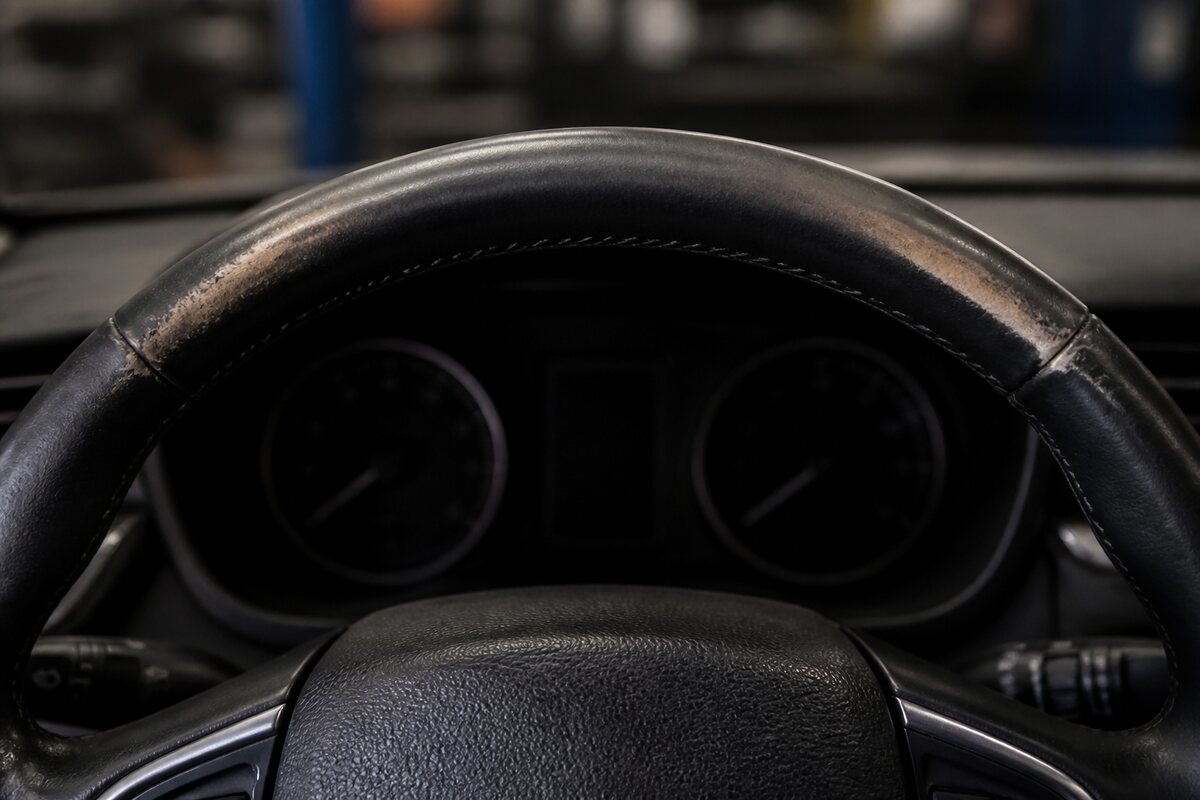
Look for a change in sheen, tackiness, color transfer and loss of grain. A worn topcoat is not the same problem as a torn cover, and a glossy ring may be residue rather than restored protection.
The wheel also raises safety and workmanship questions. Controls, stitching and the cover’s fit should remain clear before cosmetic work begins.
If the wear is broad or the surface feels unstable, a professional color and finish system is a better path than a household conditioner.
Gloss is an observation, not a diagnosis
A glossy ring on a steering wheel can be compacted hand residue, a polished topcoat, loss of surface texture or several of those at once. Compare the usual hand positions with a sheltered lower section. Look for color on a clean cloth, tackiness after the cabin cools, flattened grain and sharp pale edges. If gloss changes with gentle cleaning but color stays stable, residue played a role; if the finish transfers, the coating is no longer secure.
Hand creams, sanitizers, heat and repeated friction create a severe contact cycle. The fact that the wheel looks darker does not prove it needs conditioner. Adding oil can increase slipperiness, change sheen and complicate later adhesion. Record recent products and allow the surface to dry before judging it. A wheel is a control surface first and an appearance project second.
Keep safety geometry untouched
Inspect stitching, spoke junctions, controls and the fit of the cover. Do not wrap, fill or coat over a loose seam, moving edge or control boundary. Never dismantle airbag components as part of a cosmetic diagnosis. If the rim cover rotates, stitching has failed, the underlying structure is exposed or a repair would change grip shape, arrange qualified inspection rather than continuing at home.
Photograph the full wheel centered, then each contact zone under the same light. Close images should include a scale without placing metal against controls. The vehicle repair-scope guide covers the same principle: when upholstery work meets a restraint or control system, documentation is the safe endpoint for a general reader.
Clean only to answer a controlled question
Use manufacturer guidance where available and test a mild, compatible process on a small sheltered section. Apply product to the cloth rather than flooding the wheel. Work away from perforations, stitching and switches, then remove residue and let the surface dry fully. Check grip with clean dry hands while the vehicle is stationary. Any slipperiness, tackiness, color movement or uneven gloss is a stop signal.
A successful clean may reveal that the original finish is intact beneath residue. It may also reveal broader abrasion that needs a flexible professional color system. Both are useful results. The test has separated soil from finish condition without committing the entire rim. The product-role guide explains why cleaner, conditioner and finish cannot be substituted for one another.
Set a workmanship standard
Professional recoloring requires controlled preparation, color, grain and low-slip sheen. Ask how controls and stitching will be masked, how the coating flexes, and how the repaired band will transition into untouched leather. If the cover itself is loose or deeply cut, replacement or retrimming may be more credible than building a thick cosmetic layer over structural wear.
Evaluate the result in daylight and at night under cabin lighting. The rim should feel consistent, remain secure and show no transferable residue. Keep the products and date in the vehicle record. Future gloss can then be compared with a known finished state instead of starting the diagnosis from memory every time.
Source note: Editorial method. Accessed August 25, 2026.