Repair boundary • Furniture & Upholstery
When does a sofa need repair rather than more conditioner?
Conditioner cannot replace missing material, a failed finish, open stitching or collapsed support.
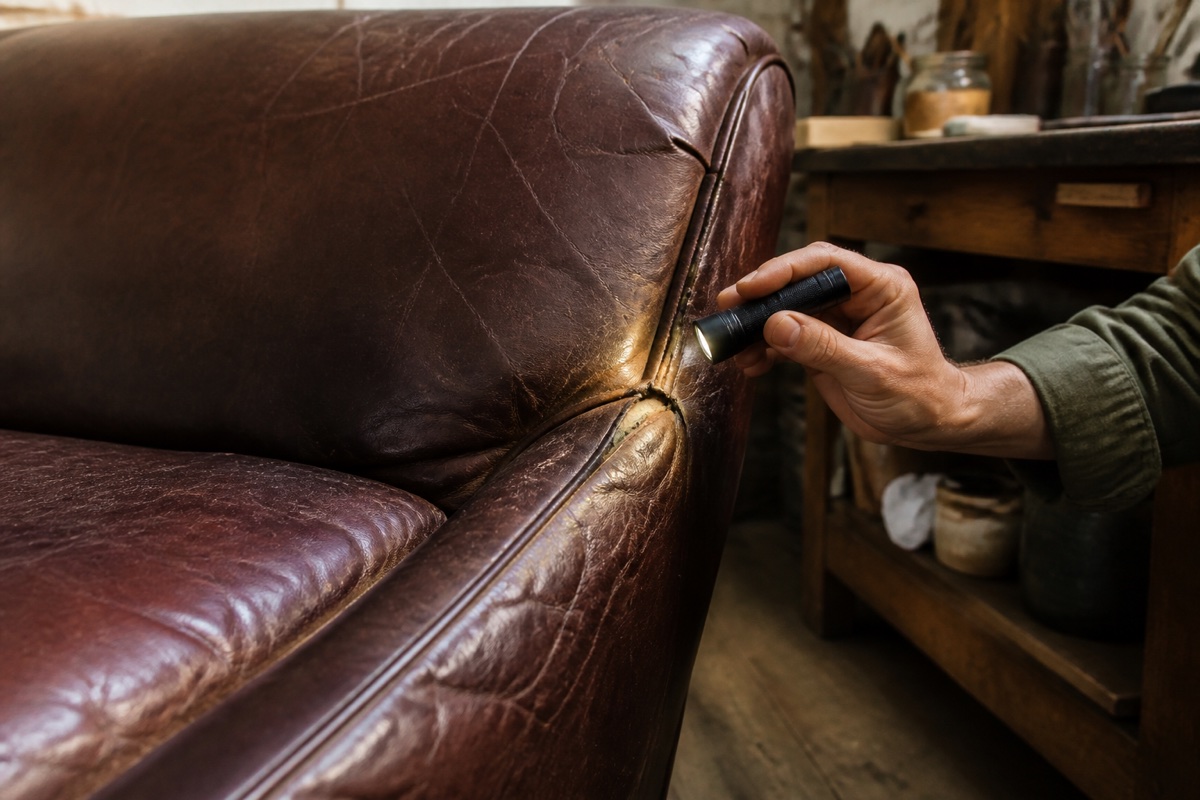
Cracks that catch a fingernail, exposed substrate, torn seams, loose panels and repeated color loss all suggest a deeper issue than surface dryness. A darkened patch after oil or silicone is another reason to stop adding product.
Use the diagnostic atlas to name the symptom, then document its size, location, movement and history. The safest next action may be a technician assessment rather than another treatment.
A realistic repair brief is more valuable than a promise of invisibility.
Conditioner cannot replace a missing layer
The word dryness is often applied to every dull, rough or cracked sofa. That description can hide several failures. A conditioner may alter feel on a compatible leather, but it cannot close an open seam, recreate abraded grain, support a weakened tear or rebuild a missing color coat. If an area catches a fingernail, exposes a different colored layer or opens when the cushion flexes, the decision has already moved beyond routine conditioning.
Repeated product application can make diagnosis harder. Oils may darken an open surface, silicone can affect later adhesion, and residue can create temporary gloss that looks like repair. Stop adding product when earlier applications are unknown or when the surface changes after each attempt. Preserve packaging and dates for anything already used, because a repairer needs that history when planning cleaning, filling or refinishing.
Look for movement and exposed structure
Inspect damage while the sofa is unloaded, then watch it during normal gentle use. Fine stationary lines in a finish are different from a split whose edges separate at every sit. Follow the line toward seams, piping and cushion corners. Damage near a high-tension junction carries a larger structural question than the same mark on a loose decorative panel. Do not pull the edges apart to prove that a tear is deep.
Check beneath removable cushions and along the platform. Collapsed foam, broken support or a shifted cover can create the folds where cracks return. An open stitch line may be repairable while holes remain intact; torn needle holes and brittle edges can require panel work. The reupholstery scope guide explains when surface access turns into construction work.
Separate four repair questions
Ask whether the sofa needs cleaning, stabilization, color work or structural upholstery. Cleaning removes compatible soil. Stabilization may support a tear or secure an edge. Color work rebuilds a controlled finish on a sound surface. Structural upholstery changes seams, panels, filling or frame support. A single visit can involve all four, but naming them separately prevents a color improvement from being mistaken for a complete repair.
Use the Diagnostic Atlas to describe the surface and the tear assessment to record access, backing and tension. Add scale with a ruler and photograph the whole panel as well as the close damage. A macro image without location can make a tiny mark look catastrophic or hide that it sits directly on a loaded seam.
Know when to stop home treatment
Arrange a repair assessment when color transfers after drying, the coating feels sticky, a crack network expands, the leather edge crumbles, a seam opens, or support beneath the cover changes. Also pause when the finish type cannot be identified and the proposed treatment depends on strong adhesion or color matching. A conservative pause is not neglect. It keeps more original material available for a controlled repair.
Ask a technician to state the expected visibility, flexibility and life of the repair rather than promising invisibility. Request an explanation of panel blending and what happens if a hidden contamination appears during preparation. The most credible outcome may retain wrinkles and shade variation while making the sofa stable, clean and coherent. That is a repair brief a reader can evaluate after the work is complete.
Source note: Editorial method. Accessed August 25, 2026.